
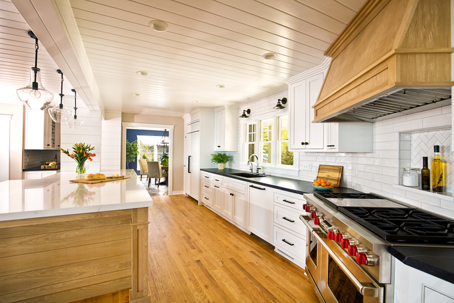
The moment you set a hot pan down on a stack of mail because there is no clear counter space, you feel it: your kitchen is working against you.
Maybe the fridge door blocks the main walkway, or you have to shuffle cutting boards, appliances, and dishes just to make a simple dinner. That daily friction is exhausting, and it usually points to layout decisions rather than a lack of effort on your part.
Many homeowners assume these frustrations are simply part of living with an older kitchen. In reality, they are often the result of common design mistakes that affect workflow, storage, lighting, and traffic flow. The good news is that identifying those problems is often the first step toward creating a kitchen that feels easier to use every day.
The Work Triangle Still Matters More Than You Think
A kitchen feels easier to cook in when the sink, stove, and refrigerator form a functional work triangle.
This long-established design principle helps reduce unnecessary walking and keeps key tasks connected. When the distance between these three areas becomes too large—or obstacles interrupt the path—everyday cooking becomes less efficient.
Many kitchens start with a workable layout but lose functionality over time. A larger refrigerator, a relocated sink, or an oversized island can disrupt the natural flow of the room.
It also helps to think beyond individual appliances and focus on activity zones. Prep, cooking, cleaning, and food storage should connect logically. If trash bins, utensils, cutting boards, and cookware are scattered throughout the room, even simple meals can feel more complicated than they should.
Not Enough Counter Space Where You Actually Need It
A kitchen can have plenty of countertop space on paper and still feel cramped during meal prep.
The issue is often placement rather than total square footage. Counter space beside the sink, cooktop, and refrigerator serves as an important landing zone where groceries, dishes, ingredients, and hot cookware can be safely placed.
According to the National Kitchen & Bath Association, kitchens function best when sufficient landing space exists around major work areas. When those zones are missing, homeowners end up carrying hot pans across walkways or balancing ingredients wherever space is available.
Common problem areas include:
- Microwaves occupy valuable prep space
- Small appliances permanently living on counters
- Refrigerators without nearby unloading space
- Islands that look large but provide little practical workspace
Sometimes, small layout adjustments can create far more usable workspace without significantly changing the room's footprint.
Cabinet and Appliance Placement That Creates Daily Frustration
One of the most overlooked kitchen layout mistakes involves door and drawer clearances.
A dishwasher that blocks access to nearby cabinets, a refrigerator that hits the island, or pantry doors that interfere with appliance access can quickly become daily annoyances.
These problems often happen when cabinetry is planned before appliance specifications are finalized. While everything may appear functional on a design drawing, real-world use tells a different story.
Island spacing is another common issue. Narrow walkways can create bottlenecks, especially when multiple people are using the kitchen at the same time. Industry guidelines generally recommend maintaining adequate clearance around islands to support comfortable movement and appliance access.
Corner cabinets can also create hidden storage problems. Without pull-outs, rotating shelves, or other accessibility features, these areas often become difficult-to-use spaces where items disappear and rarely get used.
Poor Lighting Makes Every Task More Difficult
Even a beautiful kitchen can feel frustrating when the lighting is poorly planned.
A common mistake is relying solely on ceiling fixtures located behind the person working at the counter. This creates shadows directly over food preparation areas, making chopping, measuring, and cooking less comfortable.
Good kitchen lighting typically combines multiple layers:
- Ambient lighting for overall brightness
- Task lighting for work surfaces
- Accent lighting for visual interest
Under-cabinet lighting is especially valuable because it illuminates countertops directly where work happens. Pendant lights can also be effective over islands, but only when properly sized, spaced, and positioned.
The goal is not simply to make the room brighter. It is to place light where homeowners actually need it most.
Assuming Everything Needs to Be Torn Out
Many homeowners believe a frustrating kitchen automatically requires a complete redesign.
In reality, some of the most impactful improvements involve addressing a handful of specific problem areas rather than rebuilding the entire space.
For example:
- Relocating an appliance
- Adding storage solutions
- Improving lighting placement
- Expanding landing space
- Reworking cabinet organization
These targeted changes can dramatically improve functionality while preserving much of the existing layout.
Before making major decisions, it helps to identify the exact moments that cause frustration. Is it unloading groceries? Preparing meals? Navigating around family members? The answers often reveal where improvements will have the greatest impact.
Ventilation and Storage Are Often Overlooked
Countertops and cabinetry usually get the most attention during kitchen planning, but ventilation and storage can have an equally significant effect on daily comfort.
An effective range hood helps remove cooking odors, moisture, heat, and airborne particles. When ventilation is inadequate, kitchens can feel stuffy and uncomfortable regardless of how attractive the room looks.
Storage is equally important.
Tall pantry cabinets, ceiling-height cabinetry, vertical storage solutions, and strategically placed shelving can dramatically improve organization without increasing the room's footprint.
Electrical outlet placement deserves attention as well. Outlets positioned near prep areas and islands help support small appliances without creating extension-cord clutter across work surfaces.
These details may seem minor during planning, but they often have a major impact on how well the kitchen functions over time.
Why Identifying Layout Problems Early Matters
Most frustrating kitchen layouts are not the result of one major mistake. They are usually a collection of small decisions that create daily inconveniences over time.
Addressing those issues before a remodeling project begins can help homeowners prioritize improvements that will make the biggest difference in how the space functions.
A thoughtful kitchen remodel focuses on more than appearance. It considers workflow, storage, lighting, traffic patterns, appliance placement, and how the household actually uses the room every day.
Create a Kitchen That Works Better Every Day
If your kitchen feels harder to use than it should, the issue may be the layout rather than the size of the room. Small design conflicts can add unnecessary frustration to cooking, cleaning, and daily routines.
Area Home Services provides kitchen remodeling services designed to improve functionality, storage, workflow, and overall usability. Whether you're considering targeted updates or a larger renovation, a professional evaluation can help identify the changes that will have the greatest impact.
Ready for a kitchen that works better for your family and your routine?
Call (573) 594-4513 or start the conversation online.